2026-10-07
5 signs your kid thinks like an engineer
Some kids make parents proud and exhausted in equal measure: the brand-new remote is already in pieces, the "why" questions never stop, and the expensive toy is boring after three days while the cardboard box gets a whole week. If that sounds familiar — congratulations. Your kid might be thinking like an engineer.
Engineering thinking isn't about being good at math. It's a way of seeing the world: everything can be taken apart, understood, and rebuilt better. Here are the 5 easiest signs to spot — and more importantly, what to do with each one.
1. Takes things apart to see what's inside
The classic. TV remotes, battery toys, even the fan — anything with screws is a surgery candidate.
Many parents punish this because... it costs money. But look at it differently: your child is teaching themselves how things work through experimentation. Every engineer started by wondering "what's inside." Instead of banning it, set up a "toy hospital": old, broken gadgets they're free to dissect. It protects the new stuff and feeds exactly the right instinct.
2. Asks "why" until adults run out of answers
"Why does the light turn on?" → "Because of electricity." → "Where does electricity come from?" → "The battery." → "How does a battery make electricity?"... By question five, most parents surrender.
Don't surrender with "you'll understand when you're older." Surrender honorably: "I don't know either — let's find out together." Engineering thinking runs on why-questions; every time you shut one down, you kill a forming hypothesis. Not knowing the answer is fine. Hunting it down together is what they'll remember.
3. Prefers building over watching
Two kinds of kids face a Lego set: the box-admirer, and the dump-it-all-on-the-floor-in-30-seconds kind. The engineer-minded kid is the second type — and usually ignores the instructions. They invent, they test, it collapses, they rebuild.
This gets misread as "not listening" or "wasteful." It's actually prototyping: build fast, fail fast, iterate. The exact process of every lab on earth. Give them cheap materials to fail with: cardboard, tape, and later circuit simulators — where mistakes cost nothing.
4. Can't stand things that "don't work right"
The dripping tap, the squeaky door, the frozen app — this kid can't let it go. They have to fix it, or at least understand why it's broken.
That's the seed of debugging — the highest-paid skill in engineering, and one no school teaches properly. Nurture it by not fixing things instantly. When a toy breaks, form a "detective team": observe the symptom, guess the cause, try one fix at a time. Repeat that process enough and it becomes a professional reflex.
5. Loves the "fairness" of machines
Notice whether your kid gravitates to games with clear rules. Machines don't play favorites — press the right button and it works, press wrong and it doesn't. Many engineer-minded kids are drawn to that absolute fairness, so different from the exception-filled adult world.
Programming is the perfect playground for this trait: code either runs or it doesn't. No "subjective grading." Early exposure to coding — from blocks to text — gives them a world where effort connects directly to results.
How to nurture it right
Three things to remember:
- Give them room to fail. Engineering thinking dies where mistakes are feared. Computer simulation is ideal soil: fail a hundred times, costs nothing, harms nothing.
- Don't push early trophies. You don't need a robotics champion at 9. You need a curious 19-year-old.
- Build with them, not for them. Your role is fellow investigator, not repair technician.
How many signs does your kid match? Either way, here's the good news: engineering thinking isn't a rare gift — it's a child's natural instinct, as long as nobody extinguishes it.
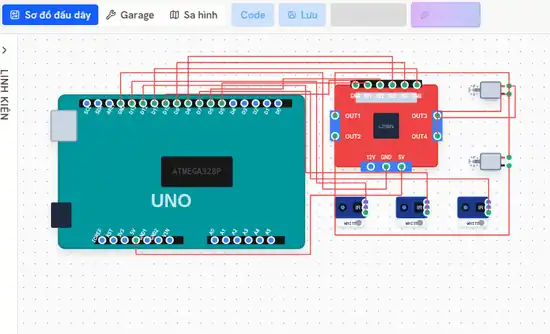
ManuStem turns these instincts into a learning journey: your kid wires circuits, writes code, and debugs — right in the browser, no kit to buy. 28 lessons from first LED to the Graduation Robot, first 4 free: stem.manusignal.com.