2026-10-07
Does your kid need an Arduino kit to learn robotics?
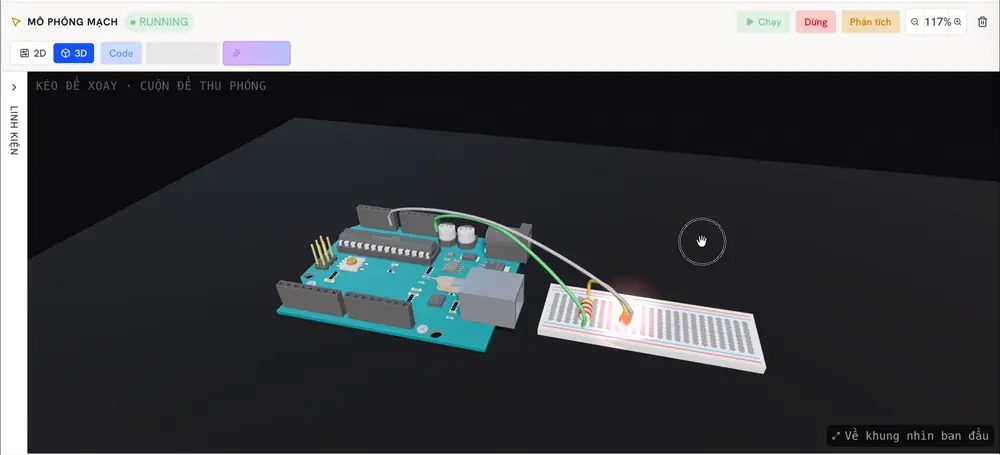
"Do we need to buy a kit for our kid to learn Arduino?" It's the question we hear most from parents. The short answer: no — at least not at the start.
The longer answer is worth your time, because buying a kit at the wrong moment is one of the fastest ways to turn your child's curiosity into a box of components gathering dust.
Why parents buy too early
Kit marketing is persuasive: a beautiful box, dozens of components, "50 projects for your kid!" Parents think: with real parts in hand, my kid will be more engaged. That instinct isn't wrong — kids learn brilliantly with their hands. But it misses three realities:
- Real parts break for real. Wrong wire, wrong voltage — a fried chip, a popped LED, real money gone in one second. That's painful for adults; for a child it can be the shock that makes them afraid to touch circuits ever again.
- Parents usually can't help. The kit arrives, the kid fiddles, the parent fiddles just as helplessly. With nobody able to debug, the project stalls and the box goes on a shelf.
- You don't know if they'll love it yet. Spending serious money on an untested interest is a gamble you don't need to take.
What to start with instead: simulation
Start in the browser. It sounds less "real," but look at what a good simulator does today:
- Your kid drags virtual components (Arduino, LED, resistor, button, servo) and wires them exactly like the real thing.
- They write real C++ and compile it with a real AVR toolchain.
- The virtual LED lights up, the virtual servo spins — wire it wrong and it "burns" virtually, costing exactly $0.
For a beginner, most of the foundational knowledge — correct wiring principles, reading schematics, writing control code, debugging — transfers completely from simulation. Physical hardware only becomes necessary when your kid wants to touch what they've built: a robot that actually drives across the living room floor.
When SHOULD you buy a kit?
Three green lights:
- Your kid asks for it. Not "buy me this," but after finishing simulated projects: "how do I make this robot drive for real?" Demand from the inside is the golden signal.
- They understand the basics. They know what a resistor is for, why ground (GND) matters, how to read a compiler error. Hardware then becomes a natural extension, not a shock.
- There's someone to ask. A parent, teacher, club, or community for when they're stuck. Kit + guide = perfect combo. Kit alone = expensive toy.
And when you buy, skip the giant "50 projects" box. One Arduino board, some LEDs, resistors, buttons, jumper wires — enough for months of exploration. Buy for the next project, not from the catalog.
The $0 roadmap we'd recommend
- Weeks 1–2: Free browser simulation. One goal only: your kid lights up their first LED and understands why it lights.
- Months 1–2: Bigger projects — buttons, servos, sensors — still simulated. Watch: do they tinker when stuck? Do they proudly show you results?
- When they ask for "the real thing": now buy the basic kit. They have the foundation; the kit is the reward.
The principle: skills first, gear second. A kid who understands the principles can use any kit. A kid who doesn't will get bored of the most expensive one.
ManuStem teaches Arduino & robotics entirely in the browser: wiring, real C++ code, real AVR compilation, 3D robot runs — break it, fix it, no chips fried, no parts bought. First 4 lessons free: stem.manusignal.com. When your kid is ready for physical circuits, that's the time to think about a kit.