2026-10-07
From Scratch to text code: helping your kid cross the hardest bridge
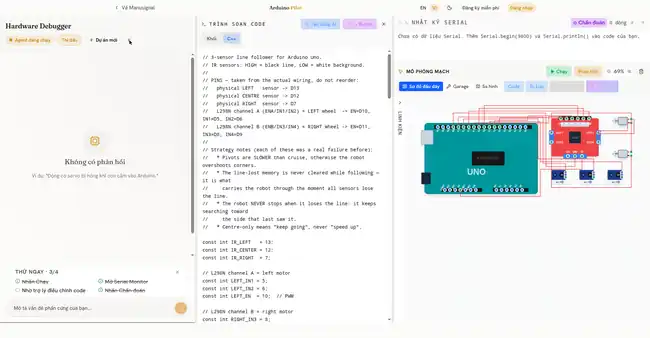
Scratch is a wonderful start. Kids drag blocks, characters move, games run — the feeling of "I made this" arrives fast. But sooner or later comes the question: "How do real programmers write this?" And that's the hardest bridge in a child's coding journey: from blocks to text code.
This is where a lot of kids quietly quit. Not because they aren't smart enough, but because the transition is usually handled badly: one day they're happily snapping blocks together, the next they're staring at a wall of text, semicolons, and cryptic red error messages. Going from "I'm good at this" to "I'm terrible at this" in a single afternoon is enough to end the journey.
Signs your kid is ready
Don't switch just because they've done a year of Scratch. Switch when you see:
- Blocks starting to feel cramped: they want to build things Scratch won't let them, or complain dragging is too slow.
- Curiosity about the inside: questions like "what IS this block, really?" or "how does the computer understand it?"
- Comfort with being wrong: they no longer melt down when a program misbehaves — they poke at it.
If none of these are showing yet, let them keep playing with Scratch. Rushing is the biggest enemy at this stage.
The bridge method: one problem, two notations
The most effective approach we've seen isn't "drop the blocks, learn code from scratch." It's doing the same problem in both, side by side.
Take the classic: blinking an LED.
- First, your kid builds it with blocks as usual: a "turn on" block, a "wait 1 second" block, a "turn off" block, on repeat.
- Then show them that exact program "translated" into the matching lines of C++:
digitalWrite(LED, HIGH);,delay(1000);,digitalWrite(LED, LOW);. - Point it out: every block they've been dragging all this time is a line of real code. There's no magic here.
That "oh, I see!" moment matters enormously. Your kid realizes they aren't starting from zero — they're just learning to write down things they already know, in another language. The fear evaporates; the curiosity stays.
Ground rules for going along
Tiny steps. One concept per session: today is semicolons, today is the for loop. Don't teach "the C++ language" — teach "how to write the thing you already built with blocks."
Let them break things somewhere safe. The biggest fear of text code is breaking something real. A browser-based simulator — where your kid wires a virtual circuit, hits Run, gets it wrong, fixes it — removes that fear completely. No chips fried, no money lost.
Celebrate the first error they fix alone. An error message isn't a bad grade; it's the computer trying to talk to your kid. A child who can read an error and fix it has genuinely crossed the bridge.
Don't fix it for them. The greatest temptation is to point: "you're missing a semicolon." Ask instead: "what do you think it's complaining about?" Slower, but your kid learns to debug — a skill worth more than any syntax.
When NOT to switch
If your kid is still deep in Scratch, mid-way through a game project they love — don't interrupt. The bridge isn't going anywhere. Forcing the switch before they're ready only breeds resentment toward text code, and resentment is very hard to undo.
Moving from blocks to text isn't an "upgrade" — it's opening another door. Scratch doesn't become useless afterward; plenty of professional engineers still sketch ideas in blocks before writing real code. Let your kid understand that, and cross the bridge as an explorer, not an exam candidate.
ManuStem is built on exactly this bridge philosophy: kids start with familiar circuits and blocks, then step by step see the real C++ behind every block they drag — right in the browser, no kit needed. Let your kid try the first 4 lessons free at stem.manusignal.com.