14 October 2026
What is a microcontroller? Explained for an 8-year-old
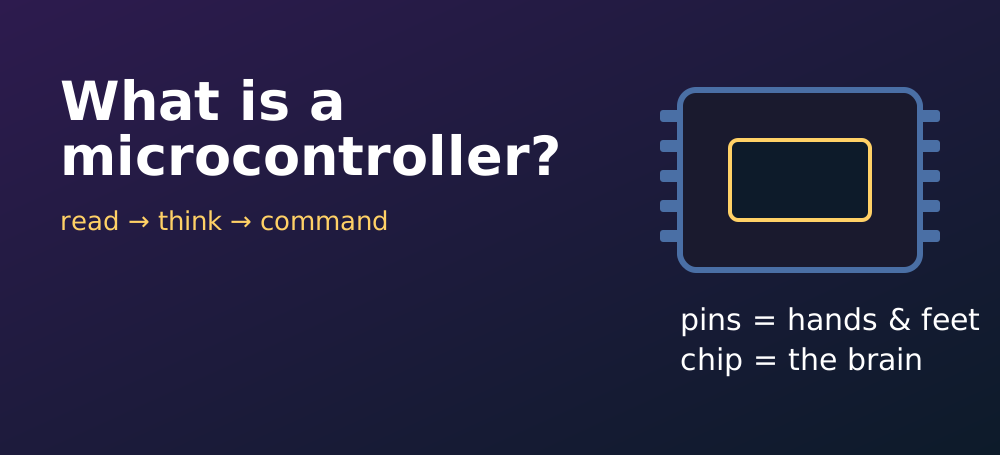
"What's this black box, dad?" — pointing at the Arduino board. The short answer: it's a microcontroller, the robot's brain. But "brain" is too abstract for an 8-year-old. Here's the explanation kids actually get:
A microcontroller = a super-fast gatekeeper
Imagine a gatekeeper who never rests, repeating 3 jobs thousands of times per second:
- Read — "is the button pressed? does the sensor see an obstacle?"
- Think — "IF the button is pressed THEN turn on the light; IF the obstacle is too close THEN turn."
- Command — send electricity out pin 9 to light the LED, out pin 5 to spin the servo.
Read → think → command. Read → think → command. That's the microcontroller's entire job — and it's also the entire content of the loop() function your kid will write.
How is it different from a computer?
Kids ask: "why not just use a laptop?" The practical answer:
- Computers are great at computing (games, videos) but have no "hands and feet" to touch the real world.
- Microcontrollers have hands and feet — pins wired directly to lights, buzzers, motors, sensors. They switch real electricity, spin real motors.
- A microcontroller does one job, but never gets tired: the washing machine, the AC, the RC car — each has one doing exactly its task.
Why should kids meet microcontrollers early?
Because it turns code from abstract into concrete. In Scratch, when space pressed just makes a character jump on screen. On Arduino, if the button is pressed, turn on the light makes a real light turn on. The moment code touches the physical world — that's when kids understand "what coding is for" with no lecture needed.
And no need to buy a real board to start: on ManuStem, kids code a virtual microcontroller, hit run, watch the virtual LED light up — exactly like the real board, minus the cost and the burnt components.
A 5-minute experiment for tonight
Open lesson 1, show your kid the Arduino board's 3 parts: pins (hands and feet), black chip (the brain), USB port (where code goes in). Then ask: "where do you think our code goes?" Let them guess. Wrong guesses are fine — that question plants exactly the right seed.
On ManuStem, kids 8+ program a real microcontroller (simulated Arduino UNO) from lesson one: write code, hit run, watch the LED light up. First 4 lessons free at stem.manusignal.com.